
During the colonization of what is now southern Ontario, the water mill was the first factory in town. It stood wherever a river offered fall — in Halton Hills mainly on the Credit River and Black Creek. The miller took a toll, hired labour, and drew in the blacksmith, the cooper, the tavern, and the post office. Each place specialized: Georgetown in paper, Norval in flour, Glen Williams in wool, Limehouse in lime, Acton in leather.
A settlement without a mill remained a farm. A mill made it a village.
After the Grand Trunk Railway arrived in 1856, local output could be shipped farther. The decline of water-powered plants came with steam, electricity, fire, and flood, Here especially between 1930 and 1954.
A Short History of the Water Mill
The waterwheel was one of the first machines to replace human and animal power.
The earliest simple mills used a horizontal wheel under the stones (the so-called Greek or Norse type). More efficient is the vertical wheel with geared drive to the millstones.
Hellenistic world, 3rd–1st centuries BCE
The first reliable references. The Roman architect Vitruvius, in De architectura (1st century BCE), described a vertical wheel, a horizontal shaft, and gearing to the stones.
Roman Empire
The empire is usually dated 27 BCE–476 CE in the West. The East continued as Byzantium until 1453.
The Barbegal complex near Arles (southern France) was built in the early 2nd century CE: 16 wheels in two cascades. Output estimates range from about 4.5 tonnes of flour a day to higher figures around 25 tonnes. It is one of the first large “industrial” machine groups of antiquity. Work stopped during the 3rd century.
China
Waterwheels already drove furnace bellows and stamp mills in the Han period (206 BCE–220 CE).
Medieval Europe
From the 11th–13th centuries the same wheel was coupled to the saw, the fulling mill, the forge hammer, the stamp, and the oil mill.
North America
Oliver Evans (United States, 1780s) built a nearly automatic mill with elevators and screw conveyors. In 19th-century Upper Canada a sawmill and a grist mill usually stood together; later came roller mills, woollen sheds, and a dynamo on the same dam.
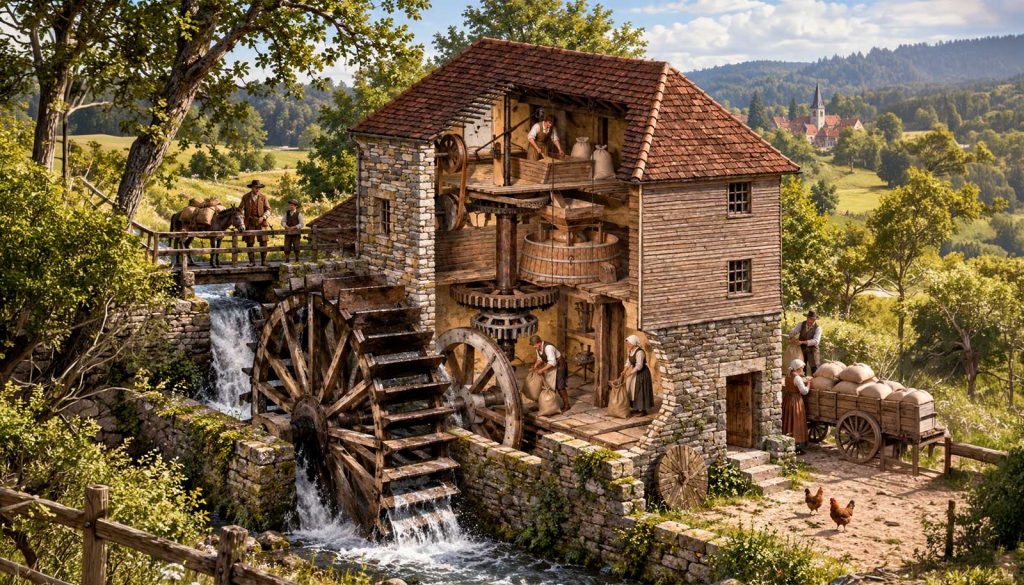
Mill Types in Halton Hills in the Early 19th Century
- Grist / flour mill / stones, later rollers
- Sawmill / boards, shingles, masts
- Woollen mill / carding, spinning, weaving, fulling
- Knitting mill / socks, underwear, blankets
- Flax mill / common in Esquesing
- Paper mill / Georgetown, Barber
- Later a power plant on the same dam
Best-Known Works, c. 1800–1950
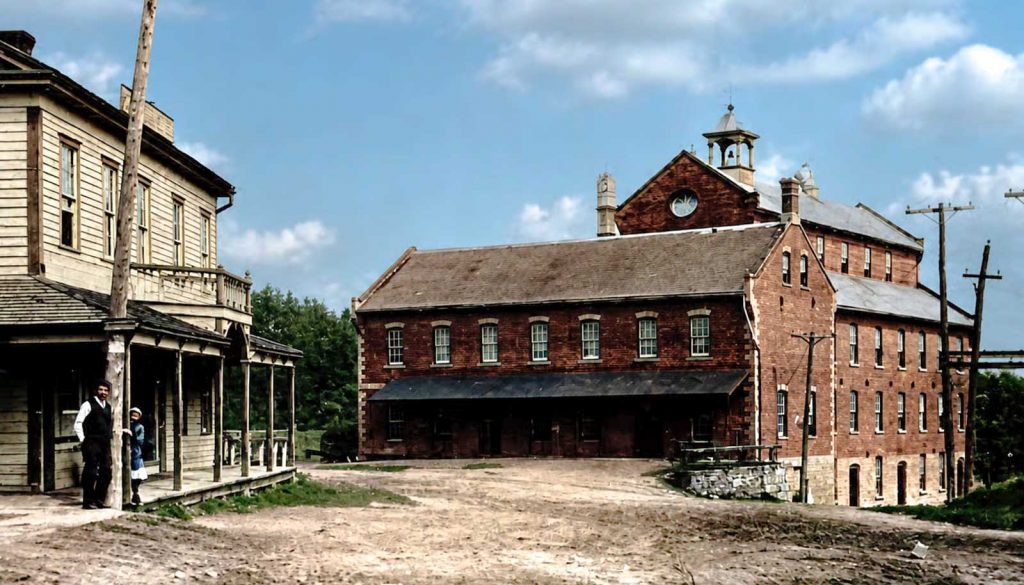
Norval — McNab / Noble Flour Mill
James McNab built a grist mill and sawmill on the Credit River (around 1828; the hamlet was McNabville). In 1838 Peter Adamson bought the site; 1845–1859 it was leased to Gooderham & Worts. In 1868 Robert Noble bought the mills and put up brick buildings. Capacity exceeded 200 barrels a day, under the brands Norval and King’s Choice.
The flour mill burned on 27–28 January 1930. The grist side continued under Browne & Co. into the early 1950s; in 1954 Hurricane Hazel damaged it.
L. M. Montgomery’s elder son, Chester, worked there in the summer of 1926. After the fire Montgomery wrote:
“It is a bad blow to Norval for it was the only industry the small village had and several families got their living in it.”
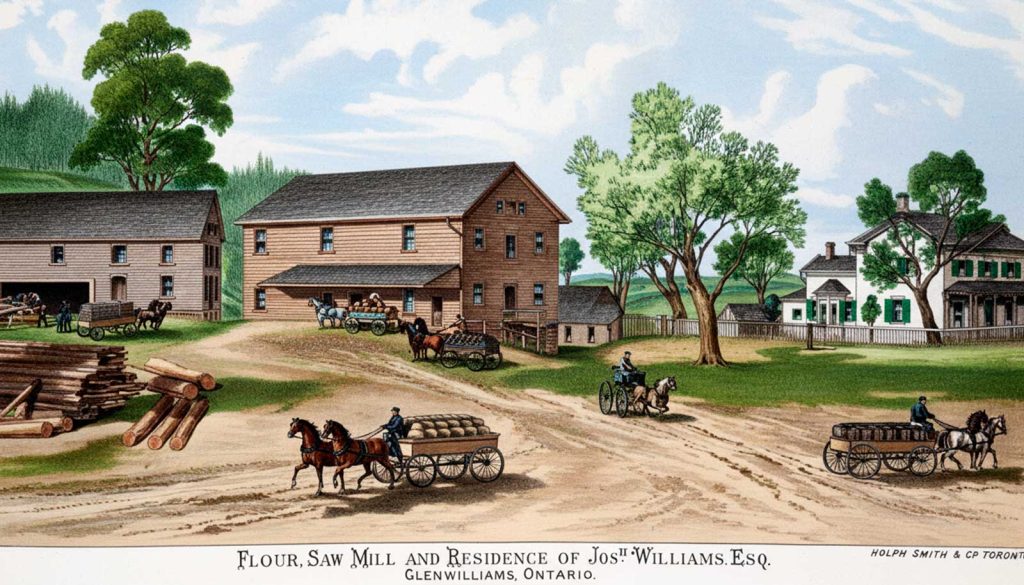
Glen Williams — Williams Sawmill (Williams Mill)
Benajah Williams bought the land in 1825 and built a sawmill (c. 1825–26). Williamsburgh grew around it (from 1852, Glen Williams). After the flour mill burned in 1890, the sawmill also served as a knitting works; Georgetown Electric Light stood on the burnt site (1898–1913). The building still stands at 515 Main Street.
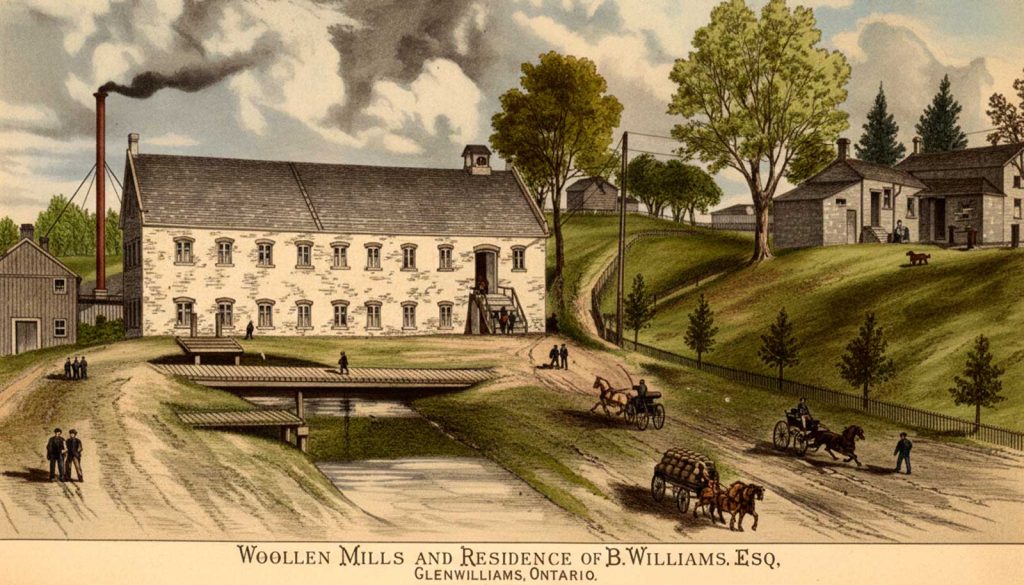
Glen Williams — Glen Woollen Mills
Jacob Williams founded a wooden woollen mill in 1839. After a fire in 1867 it was rebuilt in stone. From 1894 Sykes & Ainley ran it; from 1907, Glen Woollen Mills Co., managed by E. Y. Barraclough, a friend of the Montgomery family. Four sets of machines produced blankets, yarns, and cloth for the wholesale trade. A final fire in 1954 ended 115 years of production.
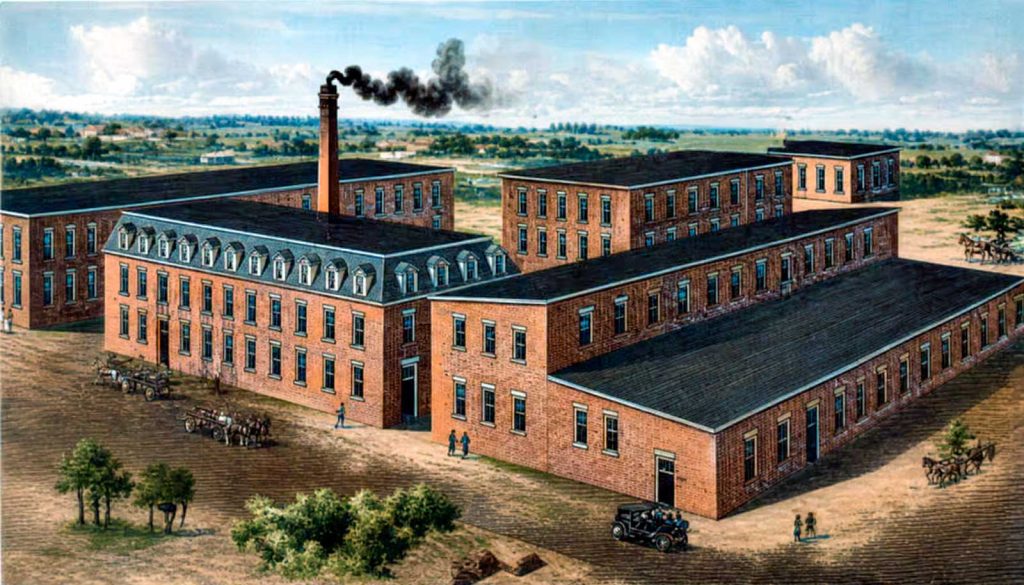
Glen Williams — Beaumont Knitting Mill
Samuel Beaumont bought an older sawmill site and from 1882 ran a knitting mill (socks, underwear, blankets; some wool from New Zealand). The family sold in 1957; production ended in 1982. The 1954 fire destroyed Glen Woollen Mills, not Beaumont. The building at 586 Main Street still stands.
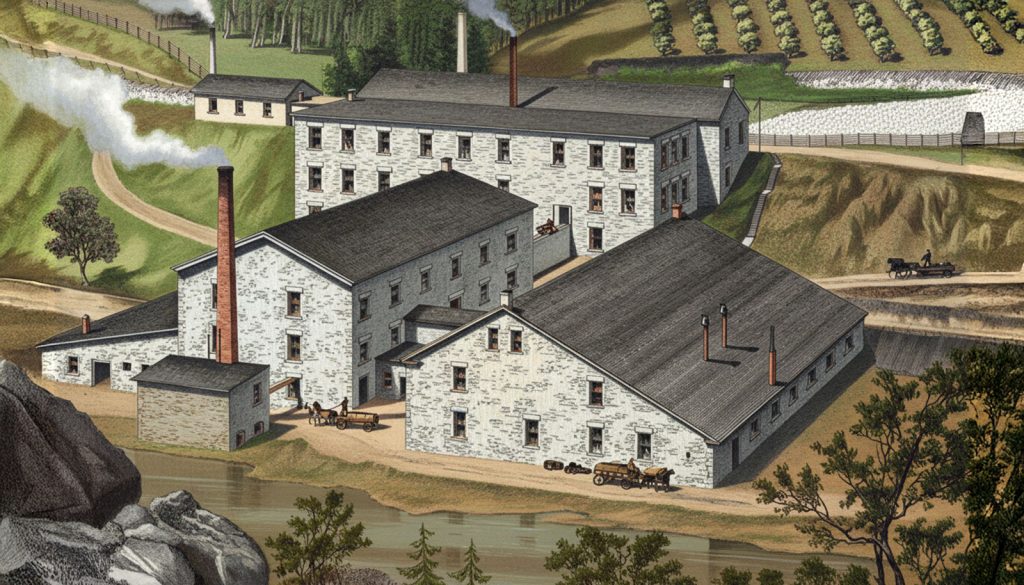
Georgetown — Kennedy / Barber and the Barber Paper Mill
George Kennedy built a sawmill and grist mill around 1823 (Hungry Hollow). In 1837 the Barber brothers bought the works and named the settlement Georgetown. A paper mill on the Credit dates from 1852; in the 1860s it was among the largest wallpaper makers in North America. In 1888 John R. Barber introduced long-distance hydroelectric transmission for manufacturing — the first in North America.
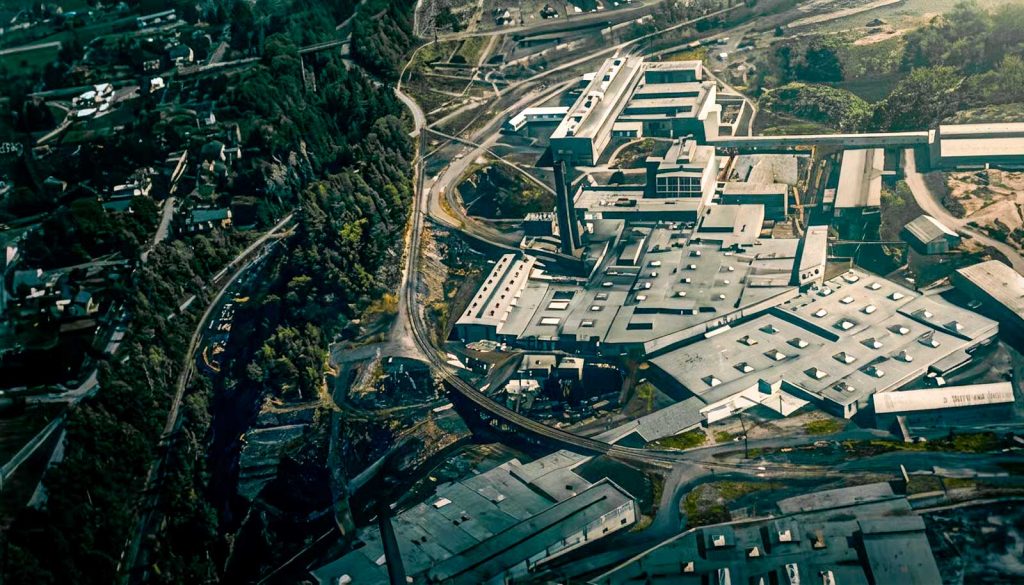
Acton — flour mill and Beardmore
A grist mill belonging to Henry Tucker, then Simon Plewes (1850–1876; he drowned in the mill race). Later known as the Lindsay / Acton Flour Mill, now in the P&H Milling line. The brands Norval and King’s Choice belong to Noble at Norval, not to Acton.
Acton’s main business was the Beardmore tannery — at the turn of the century the largest in the British Empire, nearly a million square feet, and the town’s chief employer until 1986.
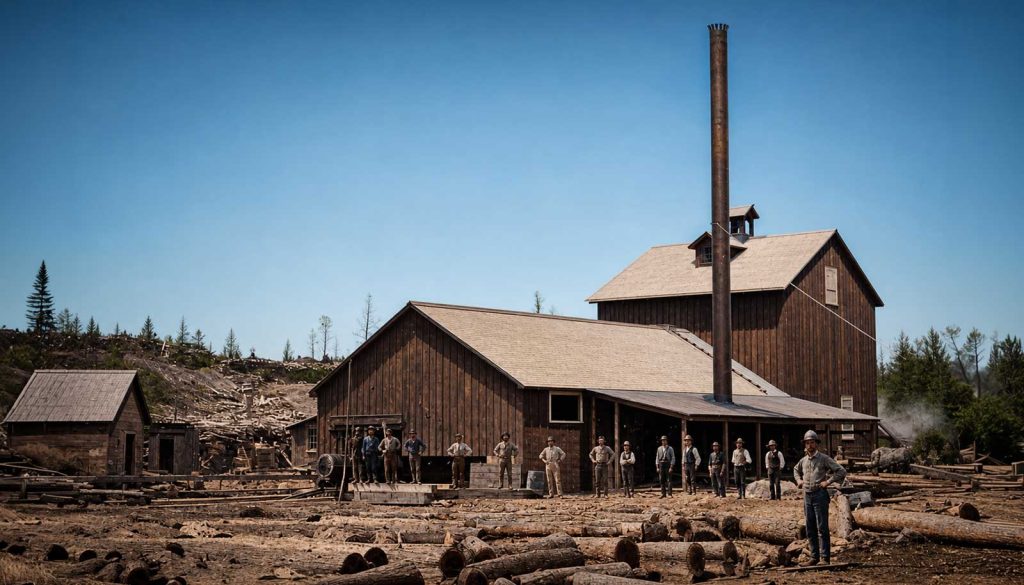
Limehouse — sawmill, wool, lime
Adam Stull and James Clendenning founded a sawmill in the 1820s–1840s. John Newton (first postmaster in 1857, who gave Limehouse its name) added the Empire Blanket Mill (1862). On 12 October 1893 a fire destroyed the woollen mill, a paint works, and the wood supply for the lime kilns. The kilns lasted into the 1920s.
Glen Lawson, Stewarttown, and the rest
After 1836 Graham Lawson built a grist mill and shingle mill on Black Creek. George and Edward Tolton took over from 1875; fire in 1882. Later a small tannery of A. T. Arnold.
Stewarttown (once Esquesing Village) also grew beside mills on the Credit / Black Creek and was an early township centre. Silver Creek and Speyside had sawmills and quarries; Hornby had the Brain Bros. maltings.
What remains
The Halton Hills pattern is short: river → dam → saw and flour → wool or paper → railway 1856 → fire, steam, electricity → silence after 1930–1954. Noble’s mill at Norval was the village’s most famous flour works. The district’s largest firms were no longer classic mills: Beardmore in Acton and Barber in Georgetown.