
When people say “Halton” today, they are actually using the name of a British man born in 1769 who could never have known present-day Milton, Oakville, or Halton Hills as we know them today. That man was William Halton, an official in Upper Canada, and this is his story.
William Halton was born in England on November 6, 1769, and died on September 22, 1821.
He came from a prominent British family and was the son of Sir William Halton, 6th Baronet.
As a young man, he entered the British Army and by around 1803 had attained the rank of captain. His career changed significantly through his relationship with Francis Gore, who later became Lieutenant-Governor of Upper Canada (1806–1817).
Halton served with Gore during his time in Bermuda and came with him to Upper Canada in 1806.
In Upper Canada, Halton became a close friend and private secretary to Francis Gore (1769–1852), for whom he carried out important administrative and political work.
He was therefore neither a governor nor a major politician in the modern sense. His importance lay primarily in the day-to-day administration of the colony: he handled correspondence, land-grant matters, military affairs, and communication between residents and the governor.
During the period of growing tensions with the United States, he was also involved in matters concerning troops, weapons, and supplies.
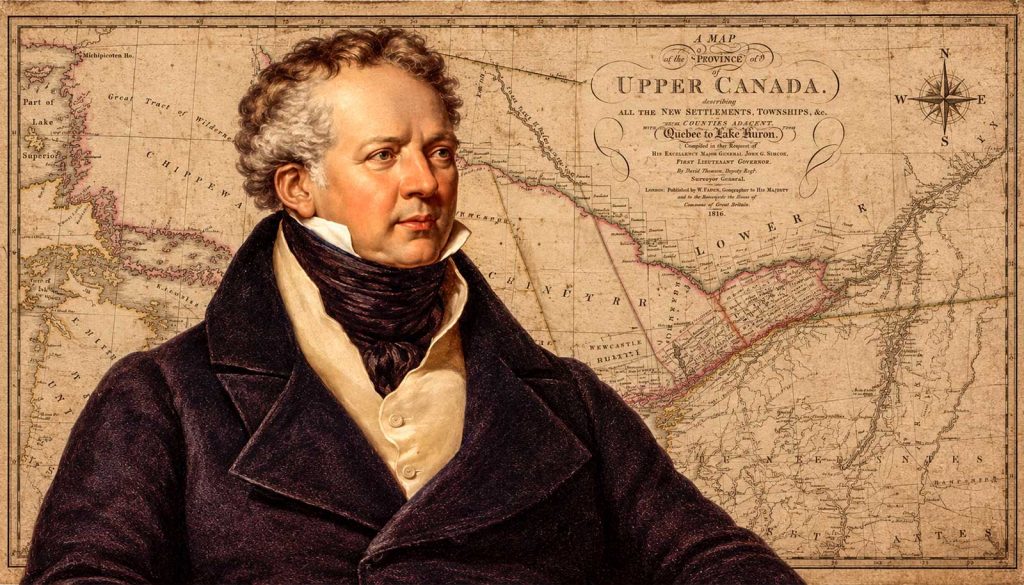
William Halton and the Halton Region
After the War of 1812, Halton was regarded as someone who had helped the inhabitants of Upper Canada, particularly veterans and their families. In 1816, he was appointed Provincial Agent for Upper Canada in England. According to records of the Legislative Assembly, he sought to assist widows and orphans of soldiers who had died during the war.
On March 22, 1816, an act was passed creating the Gore District.
Two new counties were created from parts of several existing administrative units:
Halton County
Wentworth County
The Gore District was named after Francis Gore.
Halton County was named after William Halton.The Halton of that time, however, was not the same as today’s region.
It was part of the broader administrative structure of the Gore District and included historic township territories from which places such as Trafalgar, Nelson, Esquesing, and Nassagaweya later developed.
Halton therefore became the namesake of the county not because he had established a farm or founded a town there. His name was used as a tribute to his service to Upper Canada.
Was William Halton Ever in the Halton Area?
William Halton himself probably never lived in Halton County as an ordinary settler. Historical sources indicate that he held land in various parts of Upper Canada — for example, around Burlington Bay, Welland, and St. Catharines — but his principal role there was colonial, military, and administrative.
In 1816, he returned to England, and his health began to deteriorate.
Major William Matthew Halton died at the age of 52 on September 22, 1821, in England and was buried at St. John’s Wood Burial Ground in London. His tombstone still existed in 2014, but the epitaph was no longer legible.
He therefore died relatively young, and his own life story gradually faded almost into obscurity, while his name survived in the name of an entire Ontario region.
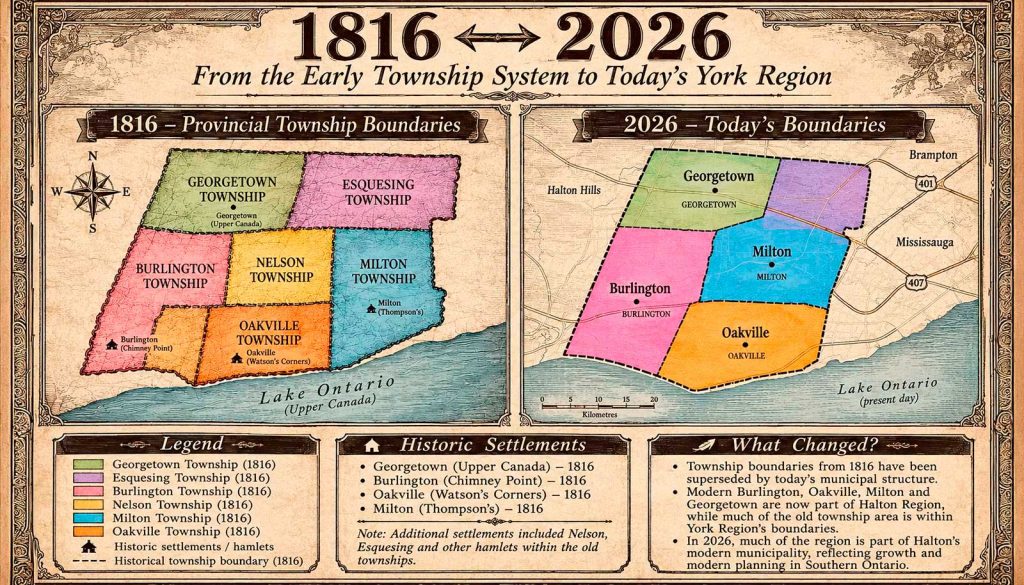
Why Is It Called Halton?
The original Halton County changed over the course of the 19th century, and in 1853 it separated from Wentworth County.
Later, places such as Oakville and Milton became part of it; the present-day Regional Municipality of Halton was not created until 1974.
So when people say “Halton” today, they are actually using the name of a British man born in 1769 who could never have known present-day Milton, Oakville, or Halton Hills as we know them today.
Major William Halton Day — An Interesting Historical Detail
The Major William Halton Day Act is an Ontario statute that officially designated September 22 of each year as “Major William Halton Day,” commonly shortened to “Halton Day.”
It is therefore not a historical holiday dating from William Halton’s time, but a modern commemorative day created in Ontario in 2014.
Why September 22?
March 22, 1816 — Halton County was created and named after William Halton.
September 22, 1821 — William Halton died.
September 22 — almost two centuries later, the date became his official commemorative day in Ontario.
The Act emphasizes his service to the inhabitants of Upper Canada following the War of 1812.
In 1816, Halton was appointed Provincial Agent in England, and in that role he sought to assist veterans of the War of 1812 and their families.
During a parliamentary debate, Ted Chudleigh, MPP for Halton, referred, for example, to a letter Halton wrote on August 25, 1818, in which he warned the British Colonial Office that people who had defended Upper Canada had still not received adequate assistance.
During the parliamentary debate in 2014, it was noted that Halton County would celebrate the 200th anniversary of its naming in 2016. Ted Chudleigh wanted the bicentennial to provide an opportunity for Major William Halton Day to be officially celebrated in Halton for the first time.
What Did William Halton Look Like?
No portrait of him has been found to date.
MPP Ted Chudleigh stated: “Not a single portrait was made of him.”
He added that no one today knows what Halton looked like.
Historian John McDonald, author of Halton’s Heritage / William Halton and Halton County, was a distant relative of William Halton. His book contains a detailed biography of William Halton.
William Halton — Brief Chronology
| Year | Event |
|---|---|
| 1769 | William Halton is born in England |
| Late 18th century | Enters British military service |
| 1803 | Appointed captain |
| 1806 | Arrives in Upper Canada with Francis Gore |
| 1806–1811 | Gore’s private secretary in York |
| 1808–1811 | Works on military and security matters before the war |
| 1811 | Gore leaves for England; Halton leaves with him |
| 1812–1814 | War of 1812; Halton works from England on behalf of Upper Canada |
| 1815 | Gore and Halton return to Upper Canada |
| March 22, 1816 | Halton County is created and named after William Halton |
| March 25, 1816 | Halton appointed Provincial Agent for Upper Canada |
| 1816–1821 | Represents Upper Canada in London, particularly the interests of veterans |
| 1818 | Intensively lobbies on behalf of War of 1812 veterans |
| 1818 | Land patent for property in Upper Canada is recorded |
| 1821 | William Halton dies in England on September 22 |
Halton Region
The Halton Region is a regional municipality in the province of Ontario, within the Greater Toronto and Hamilton Area (GTHA). It lies between Toronto to the east, Hamilton to the west, and Lake Ontario to the south.
Map
Sources
[1] The Peerage — Person Page
[2] Caledon Citizen — Many local place names come from various origins
[3] Ontario Legislative Assembly — Journal of Debates, February 20, 2014
[4] Ontario Legislative Assembly — Bill 142, Major William Halton Day Act, 2014
[5] Town of Halton Hills — Cultural Heritage Resources Assessment
[6] Town of Oakville — Historical document