
Sir John A. Macdonald, the man who made Canada Day possible. Every July 1st, as fireworks explode over Parliament Hill and families gather for barbecues across the country, we celebrate Canada Day. But behind the red-and-white flags and joyful celebrations lies a much deeper story, the story of one man whose vision and determination quite literally created the Canada we know today.
On July 1, 1867, something extraordinary happened.
The British North America Act came into force, and four provinces / Ontario, Quebec, Nova Scotia, and New Brunswick / came together to form the Dominion of Canada. It was the birth of a new nation. And standing right at the center of it all was Sir John Alexander Macdonald.
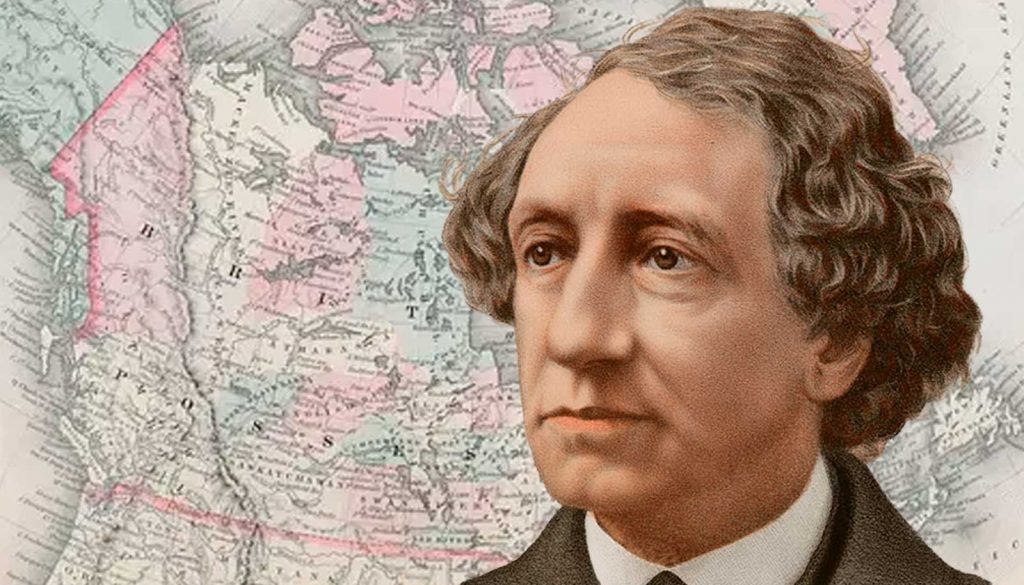
A Leader Before the Country Even Existed
Macdonald wasn’t just involved in Confederation — he was its chief architect. As one of the Fathers of Confederation, he spent years carefully navigating the complex political landscape of the time. He brought together leaders from across the colonies, convincing them that uniting would give them strength, security, and a future they couldn’t achieve alone.
The key conferences in Charlottetown, Québec City, and London were shaped by his leadership. Without his political skill, persistence, and ability to find common ground, it’s very possible that Canada as we know it would never have been born.
July 1, 1867 — The Day Everything Changed
On the very day the Dominion of Canada was proclaimed, Governor General Lord Monck appointed John A. Macdonald as the country’s first Prime Minister.
At the same moment, he was knighted for his service.
Picture the scene: A brand new country had just been created, and the man who had fought so hard to make it happen was now its leader. That’s why Canada Day isn’t just about the birth of a nation. It’s also about the man who helped bring it into existence and became its very first prime minister.
John A. Macdonald’s Story Still Matters Today
Macdonald went on to serve as Prime Minister for nearly two decades. He helped expand the young country westward, oversaw the construction of the Canadian Pacific Railway, and laid many of the foundations that still shape Canada.
While we celebrate Canada Day on July 1, his birthday is honoured separately on January 11 as Sir John A. Macdonald Day.
But it’s on Canada Day that we feel his legacy most strongly because without him, there might not have been a Canada to celebrate.
Every time we sing O Canada, watch the fireworks, or feel that quiet pride on July 1st, we’re connected to the vision of one determined man who believed in something bigger than himself.
Sir John A. Macdonald didn’t just help create Canada, he gave us the very day we now celebrate as our national birthday.
So this Canada Day, as you enjoy the celebrations, take a moment to remember the man whose story is woven into the fabric of this country.
Happy Canada Day!
The Canadian flag, known as the Maple Leaf, was officially adopted on February 15, 1965, symbolizing Canadian unity and identity.
1867 / Union Jack / Official national flag. Used on July 1, 1867 (Confederation)
1868 / Canadian Red Ensign / Unofficial / de facto First versions with 4-province shield
1892 / Canadian Red Ensign / Officially authorized for ships, Became widely used on land too
1965 / Maple Leaf Flag / Official national flag, Replaced the Red Ensign
Canadian Confederation began on July 1, 1867
When the British North America Act (now the Constitution Act, 1867) united three British colonies into the Dominion of Canada: the Province of Canada (split into Ontario and Quebec), Nova Scotia, and New Brunswick. These became the four original provinces.
Today, Canada has 10 provinces and 3 territories
Confederation laid the foundation for a federal system with powers divided between the national government and provinces. The country continued evolving toward full independence, culminating in the Constitution Act of 1982.
The process started with conferences in 1864 (Charlottetown and Quebec City) and 1866 (London), driven by the Fathers of Confederation. Key motivations included economic growth, defence against U.S. threats, and responsible government. Indigenous nations were not consulted or included in the negotiations.
Original Provinces (1867)
– 1867: Ontario (formerly Upper Canada/Canada West) and Quebec (formerly Lower Canada/Canada East): These had been united as the Province of Canada since 1841. The split created two provinces with distinct linguistic and cultural identities (English-majority Ontario, French-majority Quebec).
– 1867: Nova Scotia and New Brunswick: Maritime colonies with strong economies based on shipping and trade. Some opposition existed (especially in Nova Scotia), but they joined for protection and infrastructure benefits.
Expansion of Provinces
Canada grew rapidly westward and eastward through negotiations, purchases (e.g., Rupert’s Land from the Hudson’s Bay Company in 1869–70), and acts of Parliament:
– 1870: Manitoba — Created from part of Rupert’s Land (purchased by Canada). The Manitoba Act made it the fifth province after the Red River Resistance led by Métis leader Louis Riel. The Northwest Territories were also added at this time.
– 1871: British Columbia — The sixth province. It joined after the colony (united with Vancouver Island in 1866) negotiated the transcontinental railway promise and debt relief.
– 1873: Prince Edward Island — The seventh province. PEI had hosted the first Charlottetown Conference but declined in 1867 over land and railway issues. It joined after Canada assumed its debts and promised better terms.
The Prairie provinces followed later:
– 1905: Alberta and Saskatchewan — Created on September 1 from the southern portion of the Northwest Territories to accommodate rapid settlement and farming growth.
– 1949: Newfoundland (now Newfoundland and Labrador) — Joined on March 31 after two referendums. It had remained a separate British dominion until economic hardship led to union with Canada.
Territories (for context)
While the query focuses on provinces, the Northwest Territories (added 1870) later spawned:
– Yukon (separate territory, 1898)
– Nunavut (created 1999 from the eastern Arctic, now Canada’s third territory)
CANADA
Stephens William A. 1809-1891New Brunswick, States of Main, New Hampshire and
Vermont,
And wide New York, are on its southern front,
From Chaleur’s Bay and Lake St. Francis, and
Throughout this line the boundary is land,
The line then through the great St. Lawrence takes,
Then through the lowest of our mighty lakes ;
Then up N lagara, over cliffs so tall,
They form the world’s sublimest waterfall.
The bound’ry line here makes a southern bend,
Then west again to Erie’s western end.
Now northward turn, ‘mong lands both bright and fair,
Through the Detroit, and Lake and stream St. Clare.
Still north through Huron: near its end you vary
Your course through islands to the Sault Ste, Marie.
Then west, upon the map the line is laid
Across the largest lake that God has made ;
And here are found, upon each rocky shore,
The largest, richest mines of copper ore ;
And when it leaves the lake, the bound’ry line
Is near the parallel of forty-nine.
The line we’ve traced on cither side has written
United States or empire of Great Britain ;
Iixcept from State of Main to Chaleur’s Bay,
For both sides there are under British sway.
We’ve traced the bound’ry now on west and south,
From Lake Superior to St. Lawrence mouth,
This river’s mouth is to a gulf increas’d,
Which bounds two provinces upon the east.
The northern boundery is almost lost
’Mong boundless realms of forest, rock and frost :
Where hunters ’gainst the furry tribes make war,
From Lake Superior to Labrador. |
The turbid Ottawa by flow and fall
Descends and disembogues at Montreal:
The largest river which that monarch claims,
Whose palace rises on the banks of Thames ;
That is, the largest stream whose flowing tide
Has British land throughout on either side.
The world’s next greatest cataract is here ;
Second but to Niagara is Chaudiere.
Thus, in the largest Province in the world,
Is where the mightiest streams o’er rocks are hurl’d.
Vast rafts of timber, cut by axe and saw,
Are yearly floated down the Ottawa.
We’ll also note, along with all the rest,
It cuts the Province into east and west.And now you have, in geographic lay,
The bounds of cast and western Canada.
These were our bounds until confederation
Made us a great Dominion and a Nation.
Now Nova Scotia and New Brunswick claim
As well as we, the old Canadian name.And also Manitoba, lately plann’d,
And all the rest of wide Prince Rupert’s Land.
And Newfoundland, and |:ttle Edward’s Is!s,
Will likely soon within our Union smile:
And large Columbia, and Victoria too,Their lonely isolation will eschew,
And claim with us confederate relation,
Giving increase of pow’r and population.We on the great St. Lawrence and the lakes,
Gave up our name, which the Dominion takes.
For nearly thirty years as one we grew,But now, as once before, we are in two.
Ev’ry Province holds a local pow’r,From Ottawa, where Senate buildings tow’r.
Our central Government’s wide domination,
Extends throughout the whole confederation.