
The Fenian Brotherhood was an Irish-American revolutionary group aiming to capture Canadian territory to pressure Britain into granting Ireland independence.
In the context of the Fenian Raids (1865–1871), Georgetown, Ontario, played a small but notable role because of its strategic position on the Toronto–Guelph railway line (later part of the Grand Trunk and today’s GO Transit corridor) and its proximity to major mobilization centres like Toronto and Hamilton.
Key events involving Georgetown around 1866 (the main Fenian scare in Ontario):
The Ridgeway Crisis and general alarm
After the Fenian victory at the Battle of Ridgeway (near Fort Erie) on June 2, 1866, panic spread across Canada West (Ontario).
The Fenians threatened to cut railways, seize towns, and use them as bargaining chips for Irish independence.
Georgetown as a military hub
Georgetown was a logical assembly and supply point because:
It sat on the main rail line between Toronto and Guelph/London.
It was home to a significant volunteer militia company, the Georgetown Rifle Company (part of the 20th Halton Battalion).
Telegraph lines ran through the town, making it a communication node.
Troop movements through Georgetown
In early June 1866, volunteer militia units from across Halton, Peel, and Wellington counties were ordered to concentrate at strategic points. Many passed through or temporarily encamped at Georgetown.
The 30th Wellington Rifles (Guelph/Elora) and elements of the 20th Halton Battalion used Georgetown’s railway station as a staging area before moving south toward the Niagara frontier.
On June 4–6, 1866, special trains carrying troops, artillery, and supplies frequently stopped or turned around at Georgetown as orders changed hour by hour.
Local defence preparations
The Georgetown Rifle Company was called out on active service and performed guard duty on bridges and the railway station, fearing Fenian sympathizers or small raiding parties might try to destroy infrastructure.
Residents formed a home guard; church bells were to be rung as alarms.
Barricades of wagons and timber were reportedly prepared on the main roads into town (Credit River bridges, etc.).
The “Georgetown Scare” – June 7–8, 1866
A brief but intense local panic occurred when rumours spread that 800–1,000 Fenians were marching north from Buffalo toward Brantford or Georgetown to cut the rail lines. Militia were turned out in force, women and children sent to cellars or farms, and scouts sent south along the Toronto–Guelph road. The rumour proved false (the main Fenian force had already been broken up and arrested on the Niagara frontier), and the alarm was called off after 24–36 hours.
Aftermath and legacy in Georgetown
The Georgetown Rifle Company and Halton volunteers served on the Niagara frontier for several weeks in June–July 1866.
Several local men later received the Canada General Service Medal (clasps “Fenian Raid 1866”) for their service.
The event strengthened Canadian militia enthusiasm; drill sheds and armouries were built in the following years (though Georgetown’s permanent armoury came later).
Local newspapers (e.g., the Halton Herald) carried dramatic accounts for decades, and the Fenian scare is still occasionally referenced in Georgetown/E Halton Hills heritage materials.
In summary, Georgetown itself was never attacked or occupied during the Fenian Raids, but in June 1866 it was briefly a nervous forward staging post and railway guard point during Canada’s largest 19th-century mobilization against invasion.
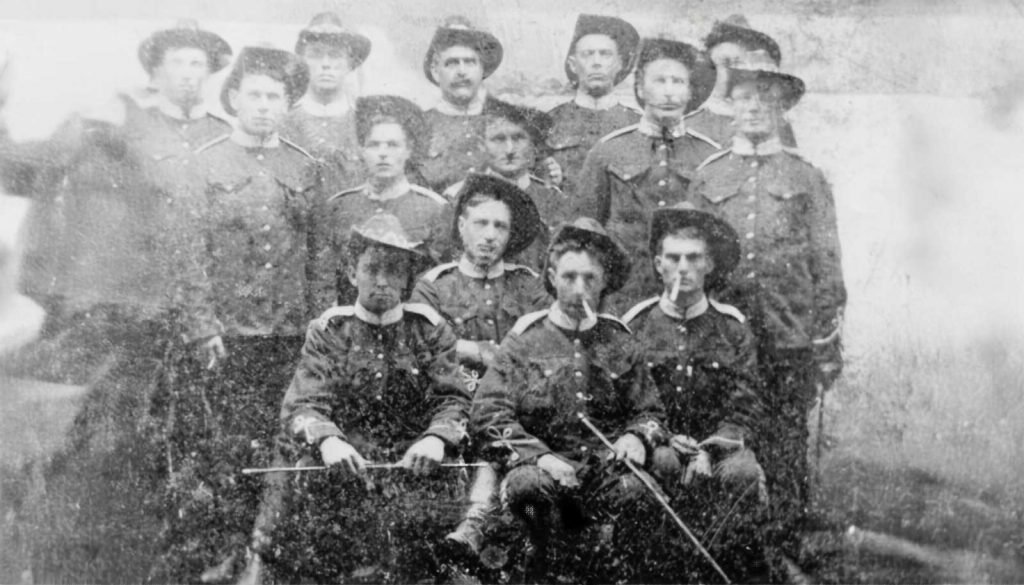
Photo: Halton Volunteers preparing for Fenian Raids c.1865.
One of oldest archived photos from Esquesing historical society
https://esquesinghistoricalsociety.com/