
Ashgrove, situated at the intersection of Trafalgar Road and 10 sideroad, has been the hub of a thriving community since 1820. It was first known as Leonard’s Corners after Edward Leonard, who purchased property on the south corner and built a hotel, naming it after himself. Timothy Street received a patent for lot 12 in 1820.
Samuel Watkins is probably the best known pioneer.
He came from Ireland in 1817. He owned property on three corners building grain storage sheds on the west corner, lot n. The farmers from as far away as Hillsburgh teamed their grain here, and he arranged transport to Oakville Harbour.
Thomas C. Watkins, one of Samuel’s sons, kept a store from 1844 until it burned in 1847.
He went to Hamilton where he established the well known retail dry goods store – The Right House.
The first post office in Esquesing township was in the store of Henry Fyfe at lot 9, concession 7.
When the property was sold to Joseph Ruddell in 1840, the post office was moved to Stewarttown. In 1852 the local people requested their own post office. They named it Ashgrove for the grove of black ash there. John Hunter was the first postmaster. He had a store in conjunction with it on the north corner. Later postmasters were Robert Smyth, Leonard Thornton, William Hood and Ida Hood.
When rural mail came in 1913, William Hayes became the first mail carrier on Rural Route 2, Georgetown. Joseph Watson and Bill Hulls also had the route for many years.
Mr. Kent had a hotel on the east corner, in 1852.
In 1869 Mr. Payne owned it. It was called Esquesing House. It had a stable on the ground floor with an outside staircase to upstairs rooms. The weigh scales, located here, were a boon to farmers selling their grain. In 1871 John Alexander built a house, a hotel and stable on the south corner. The seventh line was part of the main route from Oakville to Orangeville. The hotel was a stagecoach stop and change of horses. Drivers were Joe Ruddell Jr., Ronald Orr and H. R Thompson. With the railway expanding, the stage coach was phased out and hotel accommodation needs dwindled.
The Alexander Hotel was taken down in 1909 and the material was used to build a house on the sideroad, west of the site. Mr. and Mrs. Joseph Hulls and family lived there for fifteen or more years.
The corner lot has been a service station for many years.
The Payne Hotel was used as a paint shop by Leonard Thornton. There has been a service station on the lot since the mid-thirties.
William Drake had a cabinet making business for many years. Furniture made by Mr. Drake is prized in homes today.
William Alexander bought the east corner property in 1915. He had an implement agency and repair shop. Then Mr. Westby had a service station and blacksmith shop until it burned.
Will Drake’s son, Joe, bought it in 1940 and had a service station and convenience store until 1963. It is still being used for that purpose today by Vince Panetta.
Henry Huffman Jr. had a wagon shop east of the Esquesing House from 1880 to 1900. In 1953 Horace Barnes opened a welding shop there. His son Fred Barnes has a steel fabricating business on the same premises.
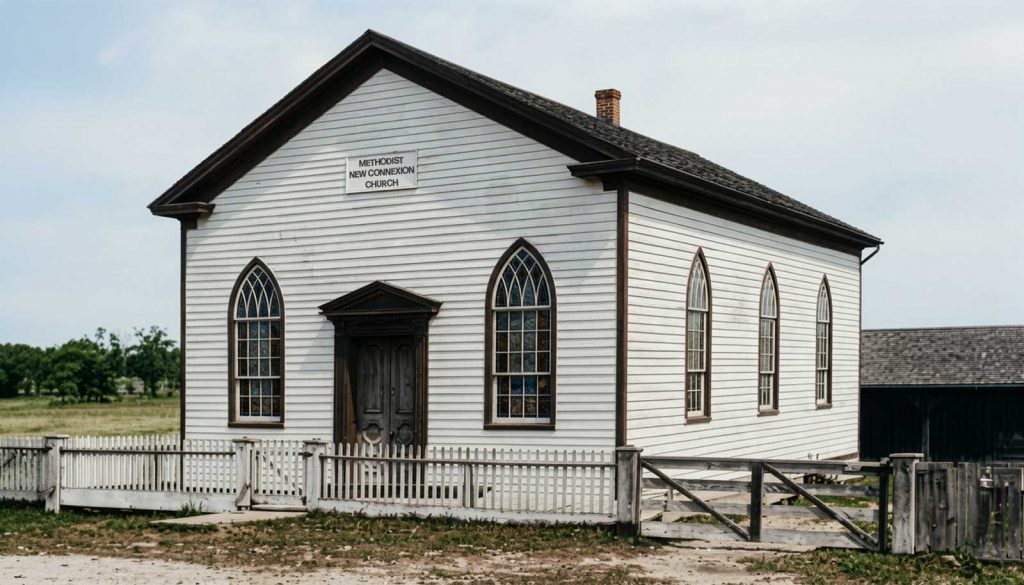
Ashgrove United Church was originally a Methodist New Connexion Church.
It was built in 1860 on land given by George Wrigglesworth on lot 9, concession 8. The carpenter was Thomas Crawford, whose wife was Barbara Watkins, a daughter of Samuel Watkins. The cemetery property across the road began on a quarter acre donated by Joseph Ruddell on which a driving shed was built. In 1877, another quarter acre was purchased and the shed was moved to the church property.
At the centennial service in 1960, four of the trustees – Fred Wrigglesworth, Arthur Ruddell, Thomas Brownridge and Frank Ruddell – were grandsons and great-grandsons of the original trustees. Their descendants are members of the present Hillcrest United Church which is an amalgamation of Ashgrove and Hornby churches.
Ashgrove church was sold in 1969 to Fred Brooks who took it down and rebuilt it as a two-family dwelling in Limehouse.
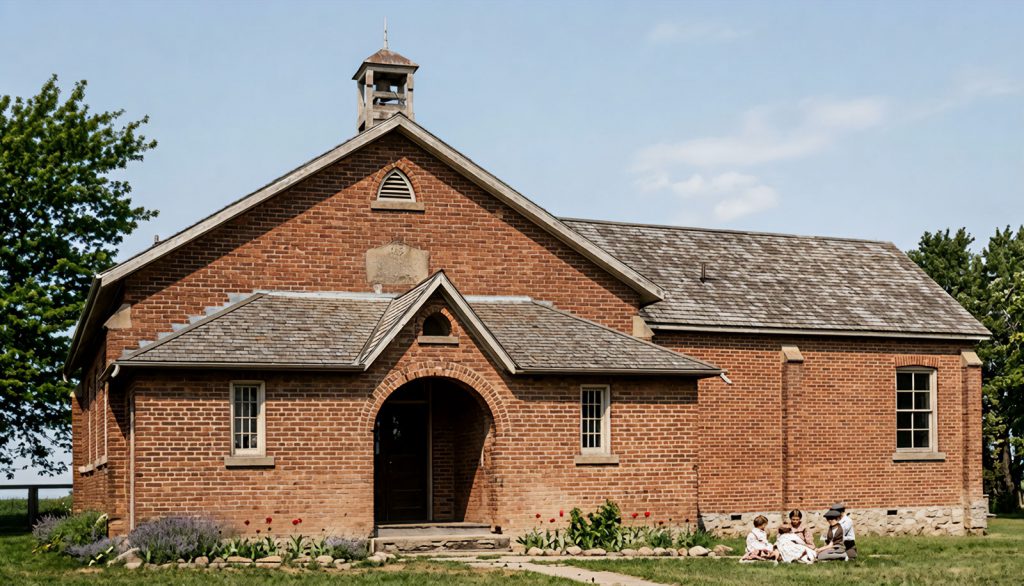
Ashgrove Public School opened in 1842 under Thomas C. Watkins as teacher.
In 1851, the School Section built a frame building about one-half mile below the hamlet. It was replaced by a brick building in 1870, with a second room added in 1878. The Green Valley saw mill opened by George Cooke, swelled the student number to one hundred. The mill was at the corner of sixth line and ten sideroad.
The school closed in 1959.
This pamphlet was written by Betty Brownridge for the Esquesing Historical Society
Many thanks to the Ashgrove Tweedsmuir History and the Halton Hills Public Libraries.
ISBN 0-921901-14-3