
The history of Stewarttown begins in 1819, when the first settlers arrived along a well-travelled Indigenous trail. For more than 140 years, the village proudly held the title “capital of Esquesing Township,” and for many years, it was known simply as Esquesing. It is also recognized as the township’s oldest village.
Nestled in a valley along the west branch of the Credit River, Stewarttown developed on parts of Lots 15 to 17 in Concessions 7 and 8, along what became Trafalgar Road. Its central location made it a natural focal point for early settlement and township life.
Stewartstown’s early settlement and founding families
The first settlers, arriving in 1819, were primarily Protestant Irish immigrants, including the Standish, Beatty, Reed, Randall, Cooke, Graham, Fee, Vance, Morrison, Thompson, and Harrison families.
The Young, Randall, and Harrison families pioneered the valley itself. James Young established an early grist mill, laying the groundwork for the village’s industrial base. In 1842, brothers John and Duncan Stewart emigrated from Ireland and settled in the area. Their entrepreneurial influence led to the village eventually being named Stewarttown.
Early government and Stewarttown as the “Capital” of Esquesing
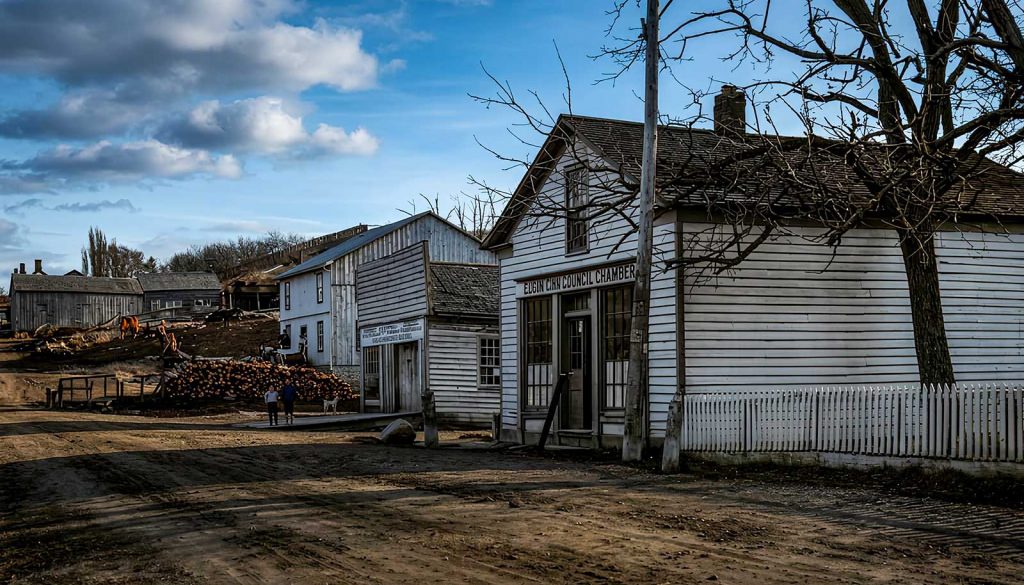
Esquesing Township’s first post office opened in 1820 at the home of Henry Fyfe (Lot 9, Concession 7). Around 1840, it was moved into the village. Although the name “Stewarttown” came into use around 1846, the post office continued to operate as “Esquesing” until rural mail delivery led to its closure around 1920.
The township’s first official meeting was held on New Year’s Day, 1821, at the home of Joseph Standish. At that meeting, key officials, including a town clerk, assessor, collector, wardens, and postmasters, were elected. Meetings continued in private homes until 1830, when they moved to “Long Tom’s” Inn on Trafalgar Road. Taverns became the preferred meeting places for many years.
In 1849, a public meeting was called to consider building a permanent Town Hall. While Georgetown strongly advocated for its construction there, private entrepreneurs had already begun building one in Stewarttown. Despite this, no official approval followed, and those builders were left financially responsible. Instead, township officials rented space near Town Clerk Richard Tracey.
This arrangement continued until 1925, when the township finally purchased the Stewarttown Town Hall, originally built around 1850. It remained the municipal office until 1962, when a new building was constructed north of Maple Avenue. Following the 1974 amalgamation that formed Halton Hills, the old hall was eventually sold to the Georgetown Little Theatre before being destroyed by fire in 1998.
Industry and commerce
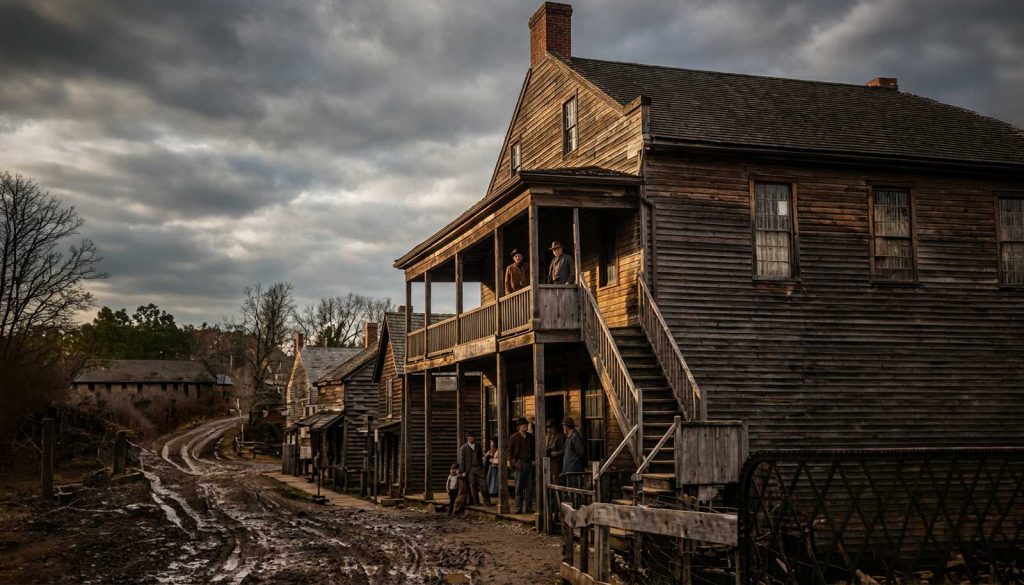
Stewarttown flourished as a busy and self-sufficient village in the mid-19th century. Its most enduring enterprise was the flour mill.
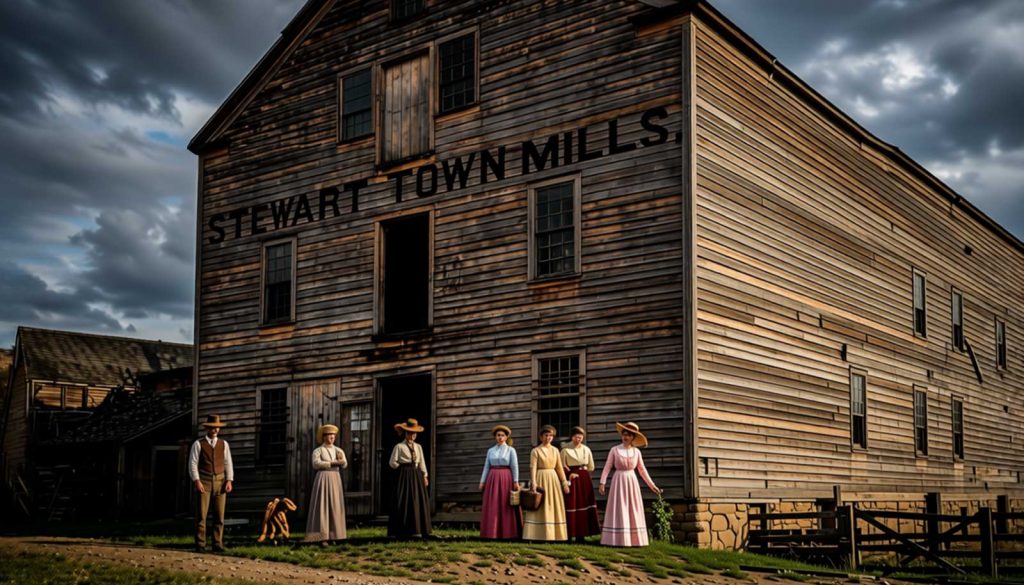
Although John Stewart received the patent for his land in 1846, he sold it the following year to William Clay and James Young, who expanded flour milling operations. Ownership passed through several hands, including Alfred Hood, David McKinnon, and Joseph Tweedle.
During the Fenian threat of the 1860s, miller Bill Stokes temporarily shut down operations so local men could stand guard.
Stewarttown’s Lawson Flour Mill
Later, the mill was owned by Henry Pratt and David Lawson, and the Lawson family continued operating it through four generations: Walter, his son Walter, Robert, and Donald Lawson. In 1962, it was sold to Master Feeds. After surviving several fires over the years, the mill was ultimately destroyed in 1972 and replaced with a store.
Beyond the mill, Stewarttown supported a wide range of trades and industries:
- A tannery founded by John Stewart and later run by David Cross
- Five shoemakers and two saddlers/harness makers (by 1856)
- Three wagon makers and two blacksmiths
- Two butchers and three grocers
- A livery stable, cooper, sawyer, broom maker, cabinet maker, pump manufacturer, tailor, and clothing shop
- Competing hotels run by James Lindsay and Alexander McKenzie
Stewarttown’s decline
Stewarttown’s decline began after 1856, when railway lines were established through nearby Acton and Georgetown. While Trafalgar Road remained an important trade route for some time, the railways increasingly drew business away from it.
The Hamilton and Northwestern Railway opened a line through Stewarttown in 1873, including a small whistle stop and freight siding. However, it closed around 1953 and did little to restore the village’s earlier prominence.
Schooling in the early years
Education in early Stewarttown required determination. Children often walked long distances to school, and stories of encounters with wildlife—such as bears—became part of local lore.
Schooling began around 1836 in the Orange Hall, followed by a frame schoolhouse on Lot 15, Concession 8. A brick school replaced it in 1853. In 1873, a two-storey brick school (SS #6) was built across the road on Lot 15, Concession 7.
Due to declining enrollment, the upper storey was removed in 1897. Population growth later led to the addition of portable classrooms in 1954. In 1958, a new school was built across the road, eventually becoming a middle school that continues to serve the community today.
Stewarttown churches and community Life
Religious life evolved. Early Methodist settlers travelled to Kennedy’s meeting house and later to Mount Pleasant. Congregationalists attended services in Georgetown after 1842, while Presbyterians travelled to Boston Church in the Scotch Block.
The village cemetery, established in 1827 on a hill overlooking the valley, was deeded to the Anglican Church, which built a church there in 1834. Due to dissatisfaction with the location, additional churches were constructed, including one on Lot 15.
A new church begun in 1850 was never completed; its materials were later repurposed to build a militia drill shed. The current school now occupies that site.
St. John’s Church, still active today, originated from the relocation of the Mount Pleasant Wesleyan Church in 1883.
Another Wesleyan church, moved in 1871 to the base of the cemetery hill, became Loyal Orange Lodge #68. It later hosted community dances before being demolished in 1974 to allow for the expansion of Trafalgar Road.
Stewarttown taverns
Taverns played a central role in Stewarttown’s social and political life. Mackenzie’s Inn, located near Bunker’s Hill, served as a popular meeting place for the Township Council and locals alike. It also hosted militia training days—events that combined drills, target practice, and social gatherings. The inn, built of pine, was destroyed by fire in 1909.
Agriculture
Agriculture was equally important—the Esquesing Agricultural Society, founded in 1846, organized competitions and exhibitions. Ploughing matches were held on the Bessey farm, while the Town Hall showcased produce and crops. The Fall Fair later alternated between Acton and Georgetown. The society continues today as the Georgetown Agricultural Society.
In 1974, Esquesing Township was amalgamated into Halton Hills, marking the end of Stewarttown’s role as a municipal centre.
Today, Stewarttown is a quiet village, but its landscape still reflects a rich and layered past from early settlement and political life to industry, education, and community traditions. Its history remains deeply embedded in the valley it has occupied for over two centuries.
Resource:
Article by John Mark Benbow Rowe for the Esquesing Historical Society
PO Box 51, Georgetown, Ontario, L7G 4T1 1999
ISBN 0-921901-25-9